


The title is harsh. We’ve been taught that as soon as we get that good job, get that career on track and have a nest egg that we should… spend it to nest in a home. Much like other mainstream advice, this comes at a high cost if done incorrectly. This article is written for average Joe, not for a top-end real estate whiz who already knows the business and can flip homes faster than pancakes on a skillet. I digress.
Here is a quick excel spread sheet that outlines exactly how we lose money by buying versus renting. An Apples to Apples comparison: interest costs vs. rent costs.
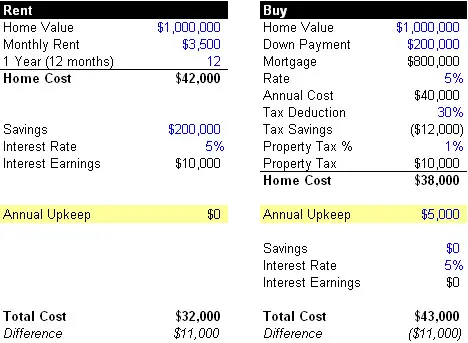
Lets jump to the assumptions
- Rent costs and interest costs are the same. Money goes into nothing.
- Tax deductions of 30% are baked into the model ($12K in this case)
- Down payment of 20% allows for lower rates, and is also no longer earning interest
- Property tax remains at roughly 1% and we assume annual upkeep costs of $5K
You’re losing $10,000+ a year by buying a home. To be honest, the overall assumptions made here are light, $5K in upkeep cost a year on a million dollar home is tiny. Every 5 or so years there are significant changes that need to be made (redo bathroom tiles, kitchen counter tops, the yard, the roof, the sprinkler system) all of this is cash flow out of your pocket to maintain the net worth of the home.
A Few Questions/Comments (Post comments below and they will be addressed):
1. “What about house price appreciation?”
Buying a home is both a call and a put option. While a house can appreciate, it can also depreciate (eg. Japan, USA in 2008). The best answer to this question is another question “what else can I do with my money?” People generally buy a home as it is a “safe” investment. Fair enough. We can still get exposure to homes by buying REITs in Bond/equity form which include companies such as NLY, AGNC, REM or bond funds such as DBLTX. Net net? Your risk to return profile is roughly the same for a non-real estate expert.
2. “Your Rates are off”
Addressing this before it even comes up, a similar return to investment as your total interest cost. Why? It’s roughly equal to the risk profile you’re taking. When you buy a home, you’re exposed to a single asset, in a single location. You’re effectively buying a single stock in a portfolio.
In addition, if we compare returns on a mortgage REIT and include the dividend payments, they suffered similar corrections to a single home.
3. “What are the Risks?”
This is the biggest misunderstood concept when it comes to home ownership. Illiquidity. Unlike a bad trade on a stock you’re leveraged in a home, you’re locked up like buying a triple leveraged index on the short side. Instead of 3 clicks and you’re out? It’s anguish when you’re wrong.
Conclusion: This flies in the face of a lot of what we are “told to do” so the biggest caveat that should be added is cash. The simple analysis above is primarily driven by the leverage you are taking on (4x ratio) and are paying interest, if this goes away and you know your stuff on the area the risk reward improves dramatically. Cash as always means options.















I see you don’t realize you’ll settle down just like everyone else and need a family.
@playboy, I do have a question though. Can you run the model to break even. Say if you were to own the home for 15 years what would the purchase price have to be to break even with renting. Thats the only option I flirt with is if you can get a house for under market value…ie fast divorce sale or medical bills so someone has to dump their house and needs cash.
@ Wiscanada:
The model runs like this in a 15 year scenario.
For the first 15 years you “lose” $11,000 as stated above each year. To put that into present value terms we use a discount of 6% to get to ~$105K of lost money.
Lets say you bought the home at age 30, 15 years later you’re 45 and 30 years later we will assume you unfortunately pass away: age 75. Since the home is paid off at age 45 (15 years later) your next 30 years you’ll “gain” 17,000 a year (plug in a zero for the annual cost since you no longer have interest payments).
So if we discount each year all the way back to the same time frame, we get to a total of… $98K!
So this is close to break even even so, not quite.
If your situation is different we can run the math for you or shoot over a spreadsheet for you to play with. The numbers are quite startling.
admin@wallstreetplayboys.com
Could you tell me which bank in the US gives you 5% interest rate in savings???
haha that’s what I was going to say! Please let me know and I’ll transfer all my funds there. More like .05%…..
The 5% is an equivalent rate.
Eg you should compare the rate of your debt to an equivalent rate in bonds whic yield roughly 5%.
Thank you for pointing out antothernpoit though.
Many people assume they should use a “savings rate” to discount their earnings when they should be using an equivalent rate.
Buying a home is nowhere near risk free eg: 1% returns.
Can you make a post on REITs? Possibly compare investing in REITs to buying a home and renting out? Thanks.
It seems like you are only taking into account the cash outlays of renting vs. buying; of course the outlays for renting will be lower, but consider this-
Although a house is not highly liquid, if you make a reasonable investment (decent neighborhood, suburban, property with potential), it should be easily sold with the help of a real estate agent to get back your initial investment (sell it for $1M principle in this case + agent fees).
So you have a net $32,000 a year going into rental property. After that,where does it go? At this point it would be in the landlord’s pocket and be considered a sunk cost for future considerations. That money is gone.
On the other hand, you have about $50,000 a year going into OWNING your own house. Of course the interest on the load as well as the upkeep can be considered sunk costs, what about the repayment of the principle?
your little theory here fails to consider the cash inflow of the disposal of the asset in question ($1M house). Since when did the theory of equity become irrelevant?
There is a lot of caveats in this post, not to mention, property taxes (not federal) are also deductible so the $10,000 in property tax is overstated.
Chase – We agree to disagree.
We would argue the average person is unable to distinguish “good neighborhood with appreciating value long-term”. In addition, 11K annual would have to be run at a growth rate similar to REITs so if you keep the principal we keep the excess cash reinvested at X rate where the math will get even uglier.
There will always be caveats to every piece of financial advice and of course your opinion is welcome.
Brother,
No one reading this forum should be considered financially “average”. I would put us all on the right side of the financial litercy bellcurve. Knowing a developing neighborhood or one that has been historically upkept is not hard to distinguish. I’m not even talking about appreciating at a respectable rate either, more or less keeping pace with inflation (holding it’s value/base amount relative to the market).
Also, as a wall street playboy looking to buy a ferrari; would you rather take out a consumer loan or purchase it using a home equity loan at the prime rate your being issued on your mortgage?
Of course, a true player like myself would use cash- but for everyone else out there, the home equity loan would be preferable. The interest paid on this loan is also tax deductible as it is tied to your mortgage, whereas the interest on a basic consumer loan is not.
Can you do that with renting? no. Will you get back your (hopefully) appreciated principle/additions to the house when you are renting it? no.
And of course you’re not going to get the return of a REIT, it’s a house. Last time I checked, basic human needs are food, water, and SHELTER.
First and foremost a house is a dwelling for you and your family (if you have one); the investment aspect is secondary or perhaps tertiary.
Many people are reading your blog, please fill them in on these (what I feel to be obvious) caveats. Us financiers and accountants can make 2+2=7 if we’d like to, simply showing people numbers mean nothing anymore, they can be bent and construed in any light we perceive them to be.
I bet I could make a graph similar to yours showing the home ownership would be the better path; moreso, I bet you could to. Its all about bending the numbers to support the cause we’re pushing.
I enjoy your blog though,
-Chase
I’m loving that 1% property tax rate. Most folks that own a $1M home in the tri state are paying at least $25K
what about inflation driving rents higher? your mortgage payment will stay the same in nominal terms over the loan period, but absent rent controls the same can’t be said of a leasehold. in essence, you need to discount the cash outflow from owning while leaving the cash outflow from renting untouched to get an accurate model. if buying is like buying put and call options, renting is akin to selling a call: you take an upfront surplus but lose with home value appreciation or market swings.
Good post pointing out some of the cost most home buyer aren’t aware of.
Everyone’s decision is influenced by personal experience. In my case I still maintain that home purchase is generally a good investment. I think you skewed your model a little bit to support your argument.
1 – $3500 rent on a 1 mil home? Unlikely. The rent would be at least $4000 if not $4500/month.
2 – As the other guy point out. Your rent will increase annually while your mortgage remain the same.
3 – the 5% interest you get on your $200,000. Same could be said for the appreciation of your home. Most home do appreciate in the long run, not as much as stocks, but they do appreciate. A 3% increase in value on a 1 mil home is $30,000. That’s a 15% return on your $200,000 down payment.
4 – The liquidity of cash or stocks is also what get inverters into trouble. If you had held your index fund for 15 years, you’ll make money. Buy home force you to lock up that $200,000 so your emotional swings won’t motivate your to buy the latest hot stock, or an impulse buy of a convertible due to mid life crisis.
5 – Home renovation cost is more than people think. No doubt about that. However the headache of upkeep is minimal. $80 a month for a gardener. 3-4 phone calls a year to get things fixed plus couple of weekends to over see the repair. No big deal.
What about multi family? Duplexes? Trading up propert a to property b without paying taxes on the sale? Apartment complexes?
This is a superficial look at the possibilities of real estate. Yes buying a single family home might not be the quickest way to earn money from your investment, it’s not impossible.