

For fun we did a quick Twitter poll to see how much people spent on their first down payment. This led to a series of various tweets and we noticed one common theme: many rich people bought a rental first. Before people jump in the comments and say “but I know so and so who bought and lived in his first place”, we already know this is true. It is one of the most common investment choices in America. Instead, we’re going to outline why doing the opposite could be good from a financial perspective. After all, if you see a trend or common theme, it is worth looking at. So we’ll run the numbers right here.
Purchase Assumptions: Before we begin here, we know that 20% down payments could be up to $200-300K in high cost areas (Bay Area, New York, Los Angeles etc.). Instead of complaining about this, we also know a 1 hour commute can give you access to properties that are much cheaper (50%+ cheaper) making them a lot more economical if you’re willing to do the dirty work. To keep this simple we’re going to use a $100K investment and a $500,000 purchase price. Why? Well if you live in a cheaper city this means you could probably pick up two homes ($250,000 each) or you could live in an expensive city where it would only buy you a home further away ($500,000). This also gives us easy numbers to work with since it’s easy to remember $100,000 and $500,000 for the home.
How the Concept Works: The one key item here is that many of the people who responded to our tweet with “purchased a rental” was this: living in a lower rent location for a longer period of time. Unsurprisingly, due to content targeted at future rich people, many of our readers live in expensive areas such as New York, the Bay Area and Los Angeles etc. The common strategy was to buy a place that was nicer than their current living standards and then rent out their purchase until they felt that upgrading would be easy. In short, they temporarily lived below the rent they could afford until their cash flows increased from their first rental property.
Scenario – Quick Math: Here is how the math would work if we focus entirely on the housing portion. If you live in an expensive city, you’re looking at total rent of around $2,000/month. This is a pretty standard number for high cost of living areas. In some cases you’re getting a studio and in other cases a one bedroom. Essentially, you can certainly live in a major city for around this number. Since “rent is going down the drain” this is another way of saying your negative cash flow is -$2,000. No equity is built.
Buying: If you decided to buy using the same assumptions, you’re looking at a $400,000 mortgage with a 4.5% interest rate (yes it could be below 4.5% but the math is easier this way) and a monthly payment of $2,027. We’ll call this $2,000 to keep it simple and by the end of a single year, you’re looking at ~$6,000 in principal reduction and around $4,500 in tax deductions from the interest. After a year you’re looking at ~$10,500 in total return. Essentially it makes economic sense to buy, the question is… could you do better?
Rental: If you decided to buy a rental instead it gets a bit more complicated but we can run it through the same way. You are paying $2,000 a month for the rental property. That said, you should be generating ~$2,500 a month in rental income (6% cap rate). Your first $2,000 goes into paying down the mortgage which we calculated above is $10,500 in returns for the first year. The remaining $500/month then goes to your bank account, so the total return in theory should be $16,500… this is 57% better than buying.
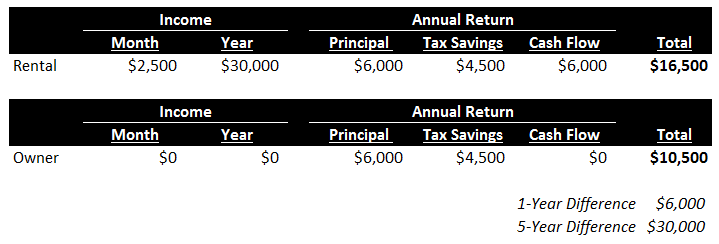
It Gets Better: Some of you may be saying, well that’s only $6,500 and my standard of living gets better. But. It doesn’t end there. Remember that if your home is used as your personal residence you cannot deduct the cost of home improvements! This is *not* the case for a rental property. Any cost that goes into repairs/improvements can be deducted. The only benefit of improvements for a primary residence is that it can be used to increase the cost basis of the home. This is a significant difference over a multi-year time frame since you can only increase the cost basis on the sale. Referring back to that $6,500 in extra income, the chances that you’ll be paying any real tax on it is next to none. You’re incentivized to improve the place (increasing value of home) and get the deduction as well. For those that own a rental, we all know there are many other tweaks to make sure you show zero profit on the rental and this is where having a good accountant and receipt tracking pays off.
How This Snowballs: Taking a look at the math above it doesn’t look incredible. The important part is realizing that the returns snowball and improve over time. If it took the person above ~4 years to save for the place it means he was able to save $25,000 a year after taxes. If he owns a rental and lives in his current situation for just 4 years, he’ll have a second rental and still have money coming in from the first rental. The $6,500 after tax difference is approximately $25,000 after 4 years so you’ve captured an entire year of savings by purchasing a rental first. We don’t have to explain it further. Once you have the second rental property, you’re now saving about half as much as you do from your normal source of income! The incremental gains have now doubled and we have assumed your income hasn’t moved one bit to help accelerate the process.
The Nay Sayers: As mentioned in the beginning, we’re not saying that this is the “only” way to do it. We’re simply trying to outline why it may work better for you versus the standard “first home is for me” mentality. When we look at the situations where “first home is for me” succeeded, they are *typically* in areas where the price of the home goes up dramatically. Think high cost of living areas that see a sudden boom like New York, San Francisco and Los Angeles after the 2008-2009 recession washed out. In these situations we can come to one interesting conclusion, if you’re going to buy your first asset you should either 1) use the rental model outlined above or 2) do significant research and play the price appreciation game over an extremely short frame. The worst of both worlds is the classic middle that most people try to do. They buy in a safe neighborhood with minimal price appreciation qualities. This means you’re simply underperforming someone who bought the same home and rented it out (math above) and you’re not getting any traction from price appreciation (person who buys high demand real estate – think beach front property).
Two Other common Options: While the majority of the post highlights a common way that people made money on their first purchase, there are other ways to make money here. First one is extreme leverage. There are situations where you can put as little as 5% to buy a property which juices your upside (and downside) tremendously. Looking at these situations you’re much more likely to take a highly levered bet when you can “force appreciate” the asset. This means you are only taking on a high leverage ratio if you are sure that repairs and hard work could offset any potential devaluation scenario. Second one is higher cap risk. This is where you’re renting in lower income areas where there are more evictions and “headaches” associated with higher cap rates. As a rule of thumb cap rates are between 3-8% or so and if you see numbers in the double digits you’re moving into higher headache environments (or a fantastic steal you’ve been researching for a long time). The one cited in our Twitter feed was trailer parks, which certainly do work if you’re willing to accept additional work 9 times out of 10.
Concluding Remarks: Unsurprisingly, doing the opposite might be one of the better decisions. In the USA, the most common move is to buy a personal home first. Unless someone is in an area where price appreciation makes up more of the value (low cap rates), reversing the process could be a better way to build wealth. While a difference in the thousands of dollars after taxes might look “small” by re-levering the same amount of money into the next property, you are able to shave many years off of your working career at minimum.















I bought a rental before my primary residence. In 2006. Since I bought it, it has increased 100k in value. Its a duplex, both sides occupied by renters at 1000 a month.
You better stick to what you know… The analysis is laughably incomplete. Like a 5-year-old describing a CAPM.
Did you really just compare rent to mortgage payments as if everything else is the same?
Just delete this and stop embarrassing yourself.
Got a good laugh, guessing you just bought a property for yourself instead of buying a rental property
lol, suprised you let that comment be posted. I refuse to pay attention to an unarmed idiot.
I second this comment he doesn’t know the difference between rental and rent!
We both should have been more clear.
I follow what you are doing a tad better now. However, why do you not have anything in the “income” column for the “Owner”? This should reflect *AT LEAST* the rent you WOULD HAVE been paying to live somewhere.
The implied number is included.
If you “would have spent” $24,000 a year you now spend $18,000 a year because of that $24,000 going to mortgage only $6,000 goes to principal.
$18,000/12 = $1,500 a month
In the rental, you still pay rent, $2,000 but get cash flow of $500/month *AND* build equity. This means the rental and the owner have -$1,500 per month in living costs.
Not sure how this is confusing, if you own more than 5-6 rentals you’ll understand why we put it up simplistically like this (you run and show a zero on tax return).
Rental guy: earns $5,000 a month, $2,000 negative cash flow for rent + $500 in rental = $3,500 *cash flow*
Owner: earns $5,000 a month, $2,000 mortgage = $3,000 a month *cash flow*.
Now anyone with excel can tell you compounding monthly versus annually gets better returns. And. Most importantly how this changes your savings/investing rate.
There is a hidden spending message in here that seems to go over people’s heads. If you’re going to buy your first home for “lifestyle improvement” you’ll actually fall backward in net worth building.
The chart is basically wrong and had me very confused.
I can summarize this post as:
You can pocket the spread between largest house you can afford and smallest house you want to live in.
These “savings” are not from rent or live-in, but from living in a smaller or bigger house.
You might as well buy a house for 250k (the one you would be renting while you rent out the 400k) and avoid all the hassle.
Interesting take at a small scale. Now ask what happens if it’s monthly spreads of $100K, does the annual versus monthly income stream not matter?
Compounding is the greatest thing in the world.
There are some alternatives, for example buying a SFH in LA or SF, and airbnb’ing out the extra rooms. This is increasingly common among DINK couples before they get kids (so the rooms would just be empty otherwise).
Ah yes, this is similar to the whole buying a duplex, living in one and renting out the other.
Exactly what I’m doing
The caveat with cities like SF and NYC is that the rent vs purchase price ratio is skewed because of the insane demand, so it will be very hard to get a 6% cap rate at the current price level.
I live in an expensive city and found the numbers to work out this way for myself, in fact they are even more extreme with my actual example home city and rentals. With the money I would have spent on a down payment in my city I purchased 15 homes in Detroit that all pay 700-1K/mo. And I still am myself a renter. Beyond the financial benefits to this month to month, I also don’t like fixing my own toilet, or losing 5% of the total value of my home to commission every time I move or upsize or downsize, so for now renting still makes sense for me.
This is *exactly* the strategy and point.
Don’t you need to hire a property manager if you’re not in the same city?
How do you deal with turnover?
Didn’t these properties require initial work? How did you discover them from afar and why not a “safer” sounding city?
Yes, you need a property manager, or better yet a business partner with some skin in the game (or some combination of the two). Hard to set up initially, but once the people are in place it opens the door to additional purchases. In Detroit my business partner and I are both remote and we rely on hired help on the ground to fix up new purchases and manage the rest. I have the same setup in another city, with a different business partner who has boots on the ground. In Detroit we buy the houes sight unseen in auctions, or have a contractor go in and take pictures and make sure there’s nothing critically wrong.
What about the rent you’d be paying to live in another place while your place is rented out?
We put the math up above. If people don’t know why having cash flow higher per month is better we should seriously do an article on monthly vs yearly compounding.
Yes, please write it.
Not sure if I get that correctly, but seems like you assume the owner lives in a property that could be rented out for $2500 a month.
The rental rents out a property for $2500 a month, but rents one for himself for $2000.
So the owner basically lives in a more expansive apartment.
“Rental guy: earns $5,000 a month, $2,000 negative cash flow for rent + $500 in rental = $3,500 *cash flow*
Owner: earns $5,000 a month, $2,000 mortgage = $3,000 a month *cash flow*.”
Agree with the concept and the underlying rational. Taking it in a slightly different direction, from a pure financial perspective (ignoring whether one has such extensive liquidity/net worth that it doesn’t matter), I’m not sure that it ever makes sense to own a primary residence? When you do an apples to apples buy vs. rent comparison in any major California or Acela corridor city, after factoring in the higher cost of P&I than rent, association costs, property taxes, insurance, capital expenditures, and generally higher maintenance costs, plus the downpayment as tied up capital factor and the transaction costs on the exit, the appreciation has to be so high to justify it from an investment standpoint. Not to mention the relative illiquidity of the investment and the immobility that it can cause, which can have more indirect negative financial ramifications. I realize the counter is to just purchase a residence where the carrying costs are more or less equivalent to your existing rent, but as you know, in any major metro that substitution will likely result in a significantly decreased living standard/quality of life (questionable location, long commute, etc.), which in and of itself can have significant if indirect consequences on earning trajectory and one’s long-term financial picture. Maybe I’m looking at this the wrong way, but it’s been a notion I’ve been wrestling with.
Well it’s not that extreme, even in nyc, California etc where prices are much higher the buying portion becomes much more timing oriented
Since you’re playing the appreciation game which an be a lot harder to calculate versus expected rental income, if you buy after a dip the returns are extremely good. Just look at nyc prices after the crash.
Original poster – I realize it’s not a Q&A but seeing if you’ll let me piggyback one off of your reply. It seems like you guys have a slightl different perspective re: attempting to time and manipulate the real estate market for appreciation as compared with the equities market. Suspending for a second your recent caveats about the relative downside of continuing to plow money into equities given where we are in the bulk market, for a long period you were proponents of a more prudent dollar cost averaging into the SPY, etc. Not talking about forced appreciation or cash-flowing real estate which are, to a large degree, anti-cyclical and independent of macro tends, but it sounds like as a general proposition, you take (or are on board with) a more aggressive approach to trying to time the general real estate market and make significant bets based on that timing as an investment strategy, no? (As opposed to just continuing to buy into minimally appreciating 8-cap cash-flowing assets, which could be viewed as the equivalent as dollar-cost averaging into the SPY.)
Funny as this comment also applies to a few post back where strategy is changing with the times. Gone are the days of reading through the Sunday paper looking at three line real estate listings with no pictures and looking up property tax info on prior owners and last sold price, DOM of a listing was something that only a realtor had access to.
There was a time that I owned property in Hawaii getting rid of it for a major windfall in 2011. Shortly after this AirBnB thing started making news and I thought it was all bullshit, fast forward a few years and it is a legitimate business model.
Hawaii is one of those funny places where it is a high barrier to entry but provided favorable tax laws for real estate, less than 1% base on assessed value, they even let you protest the assessed value of your property if you think they got it wrong. Land being scarce in some cities they allow for CPR (sub diving up an urban plot for a 2nd home).
Could be a viable option if you are a person who has a high enough income and can work remotely. If you got a fat 401K balance I believe you could borrow up to 50% to go towards your down payment (in anticipation that stock market growth may slow down in the following years) for purchase of a primary residence or 2nd residence but not a rental.If you are one of those people or couples that can qualify for a 1mil + mortgage it is still insane that you can get that type of leverage for the interest rate they are at now…try getting $1Million dollar loan that same interest and terms to start a business, no fucking way without proof of good cash flow and assets.
Back to the point, buying a primary residence can make sense if you target a vacation destination with intent of establishing residence there (for tax purposes) and doing the AirBnb or VRBO thing. Also get the perks of the business write off and little stuff like hire house keeping service so you can live like a baller (should not be wasting your time doing shit work like that). There are property management company that handle AirBnb’s, and Stuff like wifi electric door locks, nest thermostat, and wireless cameras make it so you don’t have to even be around to check your guest in.
Avoid any HOA type of communities as they are always trying to regulate AirBnB rules. If you buy into a luxury area your neighbors will hate you for doing this. Some cities and state are requiring your to report AirBnB income as business revenue and taxed accordingly.
Not really a way to start to build wealth like outlined in the post but a possibly a way to accelerate wealth if you can pull it off.
Interesting post on vacation rentals and the potential gains, will look at this further.
This post make sense, i am now contemplating if I am going to get out my current home, and rent it out. I am currently living in vegas
So far I’ve bought two apartment complexes cashes and still no main residence. Looking at buying another cash soon. I’ve found I can get steals with all cash offers from the rich people and juice returns on leverage down the line as other investments pop up and if not then I’m not paying mortgages.
In general I get 10-15% unleveraged returns at redevelopment and then no issues from then on out. Properties have appreciated hundreds of thousands as well post developments.
One more building will put me around 100k a year in rental income as a mid 20 year old. Rental income is more robust for bear markets as well if it hits in 2020 which I can then shift cash flow to mopping up on cheap properties and stocks.
My buddies are busy buying houses destroying their cash flow with big mortgages relative to their cash flow for higher standard of living. You don’t win the game playing by societies guidelines.
This one is interesting, did you use leverage to get the first one or sell a company and jump straight into an apartment complex purchase.
Lent money on the deal, during the development got it converted to a large portion of equity which has since about tripled in value. Cash flows still too strong to consider selling so I’ll keep it.
I’ve been working and investing since 13 so I had well over 6 figures saved graduating undergrad at 22 when I got that property. Then making 6 figures a year since in cheaper areas of the country (while having another high earning girlfriend) allowed us to pick up another complex cash without leverage and we make so damn much a year later we are eyeing another complex cash… cash is flowing in so fast we can’t invest it fast enough into deals… good place to be I suppose. Keep in mind buying all cash can allow you to get massive discounts too from distressed sellers, the last deal I got I was able to get for 65.9 cents on the dollar because I could buy “as is”. Banks require every little item to be fixed before closing. And since I’m just going to redevelop the place anyways I don’t care about it’s current condition besides the bones of the property.
After more deals become available we will get mortgages to free up capital but no point having excess capital that can only get you 2.5% while you look for the next deal when it can get you 10-15% as equity in the property – and when you have excess capital already. So far I have no leverage in my life though.
We both own multiple successful businesses but we haven’t sold them… why sell great cash flow items after all? We are just ramping up.
– buy a crap house on a good piece of land in a developing area (land value goes up roughly on pace with inflation +1%)
– rent in low-cap neighborhoods (small condo best location)
that was how i set it up.
Good balance of yield vs living in desirable location (2% cap rates)
Currently looking at fourplexes for my first purchase to live in and rent out 3. Using the leverage model to purchase with first-time homeowner grants to cover the down payment it’s possible to get into a building with zero money out of pocket.
For a purchase price of 350k at 5% interest (being aggressive here to factor in mortgage insurance if necessary), and living in one unit as required by and FHA loan for at least 1 year. Basic calculations show that with an average rent of $700 per unit, monthly income for keeping 3/4 rented is $2,100, with your monthly payment being about $1,900. You are up $200/month instead of paying rent for a year, plus tax deductions for any repairs/remodeling you do as mentioned above.
If you suck it up for 2 years, odds are you have enough to put down a large down payment on a nicer house you actually want, which will essentially trade in your newfound rental income (from the unit you vacate) for a reduced mortgage payment because of the larger down payment. Now take the money normally allocated toward rent/mortgage and save it up for a down payment on the next rental (either buy and immediately rent or level up your primary residence and rent out the old one).
In an ideal scenario you have at least 2 different income streams throughout all of this to expedite the process. Worst case scenario if you don’t turn your rental into a profit generating source immediately, you can greatly reduce your cost of living to catapult yourself to a higher standard sooner than if you simply bought to own right off the bat and then saved up after paying your mortgage. The difference you would save between rent and a mortgage on the same place won’t outpace rental income from a separate property vs. rent/mortgage on your own.
Awesome summary thanks!
I’ve done this a few times already. It def. works. Problems become with bad tenants. That’s the tricky part…I almost wished I’d hired a management company from the get go to help with this and maintenance. Fast forward 15 years later, I’ve done very well, BUT I still self manage, and often wonder if I should be outsourcing to free up time, because once you start multiplying it can be a major time suck
Another option if you have a high income/cash flow:
Bought a piece of land for $1.6M in the one of the most desirable areas in my country. (Its worth over $2M now).
Cost almost $2M to build so around $3.6M all in. Everything ultra high end.
Appraised value $5-5.5M.
Live in it 1 year, sell, rinse repeat.
I have friends that have done this up to 12 times, huge increase in net worth for them.
How is this even controversial? Building equity in a home while getting incremental cash flow > building equity in the home without the cash flow.
I’m waiting for your next post on how to run the numbers haha
Because in America the most common move is to buy the “biggest house they can afford”
Versus using all the capital to see if they can get a better yield on their money
Always spot on. 3 Investment properties and still living in a HCOL in a 1000$ rental while in a B2B sales role.
Gotta always keep your eye out to arbitrage the right space. My only regret is not going all in more with RE a few years back.
Main goal now is to keep searching for the ideal perfect setup for a long time personal residence with every single requirement.No rush at all.
– View
– Size
– Transit
– Neighborhood
Though I will say talking about buying rentals at all time high valuations is pretty tough. I know you do not do questions but maybe you can give us your thoughts on time frame to the next real estate pullback.
Thanks for this WSPs
An article close to my heart. I’m the only person I know who does this
Here’s my numbers
I rent an apartment in great area of my city £1350 a month (would cost £400,000 to buy) so around 4% yield for my landlord (before any insurance / maintenance – for example roof needs a £5k fix this year alone)
My portfolio of 7 units brings in £2000 a month net cashflow (after all costs). Cash put in was £150k. In last 3 years I have had at least £50k equity gain also from forced appreciation / fixing up.
I don’t know the exact return but I know it’s insanely higher than buying one primary residence. And monthly compounding means i can buy another property a year from cashflow alone on the rental income.
99% of people would have bought the property I live in for £400k and used the money as a down payment
I’m soon going to go rent a cheaper place and double down on investments
Is there a specific upside/gain to doing it the way you proposed in the article vs…
as soon as the ‘idea’ to buy a home pops into ones mind, to simply stay frugal (concerning the living situation), think about what price one would have been willing to pay for the home, and then simply take on the same amount of debt and invest it into the markets!?
Isn’t the core/fundamental advise here to delay gratification, spend less and invest more!?
Or are there specific upsides from real estate vs any other investement, like tax-wise or whatever, that I as a financial beginner/newbie don’t yet get!?
Kind regards