


We recently wrote about some quick tricks to hacking your 401K and many emails came in about a Roth IRA and tax rates for the future. So we went ahead and pulled up the data. You’ll see some surprising numbers, namely that there was a 70% historical income tax rate back in the 1970’s.
40 Year History of Personal Income Tax Rates for a Single Person:
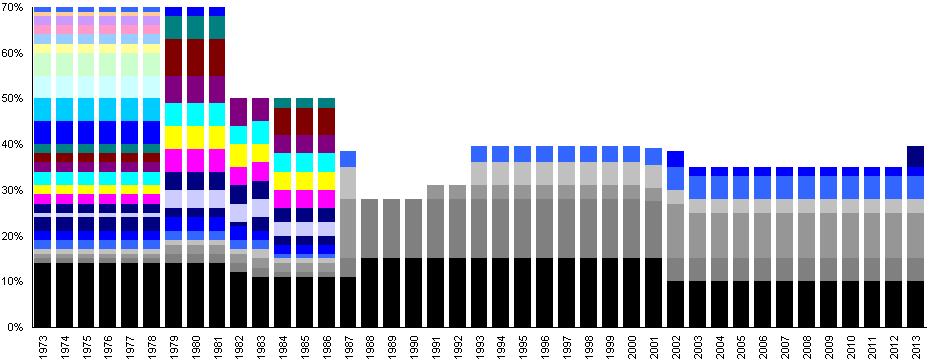
1970’s: Back in the 70’s there used to be 26 different income tax brackets growing from a 0% tax rate to 70%. Luckily, this slowed down in the future as tax rates came down over time but you can see the tax rate is quite spread at this point in time.
1980’s: During this time frame you saw an enormous change in taxes, starting with a max tax rate of 70% moving all the way down to a simplistic two tax rate policy at 15% and 28%.
1990’s: At this point the tax rate climbs again and settles into five tax bracket system at 15%, 28%, 31%, 36% and 39.6%. This remains as the standard set up until the 2000’s.
2000 to Present: Finallylooking at the present day we have a relatively simple tax system where the max rate remained at 35% until recently bumping up to the 39.6% level in 2013.
Here is a graphical depiction of the historical income tax brackets. Each color represents a new income tax bracket. To confirm all of these numbers simply visit the tax foundation.
Impact On Your Life: This website is designed to encourage people to become part of the highest income bracket (avoiding the 99%) as soon as possible . With that in mind it makes even more sense for a person to do everything they can to avoid paying taxes in excess of 15%. So here’s the step by step assuming you will eventually make it into the highest tax bracket.
– Receive the company match in your 401K since this is free money or a 100% return
– Immediately roll over the net amount into your Roth IRA
– You will pay taxes on the roll over, however you will unlikely be in the highest tax bracket just yet
– Wait out the 5 year rule and pull out the principal
– Begin buying securities again
But What About When I Turn 65? Here are the major issues with the 65 year waiting period to withdraw your money from your retirement account. 1) They can increase the age of retirement at the drop of a hat, 2) You will likely be above the 15% income tax bracket when you begin withdrawing money so your tax rate will likely be above 25% relative to capital gains taxes at 15% and 3) you are illiquid.
Now if you disagree with the future of income tax rates (reiterate tax rate highs of 70%) and possible changes to retirement age, the main issue is that you are in fact illiquid. If changes to tax schemes occur over the next 5, 10 or even 20 years you want to be able to instantly move your money elsewhere. If anything the more liquid you are the safer you become as exhibited by the Cyprus debacle. Finally, the 5 year roll over provision could also be changed instantaneously.















This is interesting its always hard to understand tax rates until you look beyond the past ten years. 70% tax rates are absurd!
With more and more people finding ways to search for jobs abroad and the laws changing frequently, there is always a high probability for numbers to move higher.
People underestimate the value of being free… Too many people buying homes at early ages losing their ability to move. Very similar to putting your money away for over 30 or 40 years…
Say I have let’s say $9,000 in a company 401k (I no longer work there) and $7,000 in a Roth IRA. Are you saying I should roll my company 401k into the Roth IRA and that I can then, after waiting 5 years, withdraw the principal (not the interest) from the Roth IRA penalty-free?
Sorry I am a newbie at this — feel free to link-drop anything I should read. I have been out of the company 1 year and feel totally illiquid having a combined $15k just sitting where I can’t get it.
The answer is yes that is how it works. In terms of deciding if you should do this you need to calculate what your income tax bracket is going to be this year compared to next year, that is how you decide if you should roll over.
If you will be moving up to a higher tax bracket next year and are certain of this, it makes almost no sense not to pay taxes on the $10K now if it does not move you up a bracket.
As an example. If you have $10K in your account. You roll it over to a Roth IRA, now in 5 years you can take out that $10K penalty free (current laws as of this posting). You will pay taxes on the $10K in the year you roll it over.
In 2013 = rollover $10K pay taxes on it = ~$3.5K paid (assumes 35% tax rate)
In 2018 = Can withdraw $10K into your personal account.
That is the current rule, call your brokerage account and they will confirm for you as well. Call their “Roth specialist” or ask to speak with their Roth IRA account manager. Should be free of charge.
WSP You’re the best.
Don’t know if my prior message posting went through or not. Here’s my situation
I have a 175k loan outstanding (it was originally off an investment loan but now living in house)
The value of my house skyrocketed (I gambled and it paid off) and current value is at 500k
I am refi the loan to 2.875 for 15 years which reduces my payment vs the 30 year loan at investment rate.
I am a single father, make good money and currently have a car that’s all paid off I am thinking about getting a “me” car vs one that’s more for lugging around kids. I know sounds dumb but I’m single and would like a nicer car to drive only occasionally.
I am told I can borrow up to 80% of the home value worth.
Would it be smart/dumb to borrow more than the 175k when I refi?
What you are attempting to do is Leveraged Buyout Math. We’ve gotten quite a few questions regarding houses so we’ll move a calculator to the front of the list of importance. In the end it is up to you to decide your risk tolerance.
Nowadays some companies even offer low rates on interest only ARMs which means you’re making a leveraged play on price appreciation only. This of course means if the price declines you’re also levered on the downside. The reverse is true on your 15 year plan so you need to run the math on all the options.
We’ve gotten so many questions on this we’ll make a post this weekend addressing housing math.
Congratulations on the price appreciation, depending on your situation and life long goals it may be smart to make a less risky play by doing the 15 year loan but again always always always run the numbers. They don’t lie.
In terms of cars, overall we don’t like them as they decline in value so levering up an appreciating asset to buy a double declining asset makes the math even worse. But we’ll start with housing only first.
The other thing is that with all the loopholes in the tax system it makes it even harder for the government to continue taking money from your paycheck. Sure you guys know but the Apple tax avoidance was a great example. As the world changes so will the ability to move to tax havens. No point in paying additional taxes nowadays.
Its really interesting when you look at numbers like this on a historical basis, we’re complaining about 35% but people have paid double that!
You have to put it into perspective though. With inflation 1970’s money was worth a lot more than 2013 money
Make sure to ask around at your place of employment and get their newist list of updated retirement plans. The Roth 401(k) is emerging but it’s kept on the hush from the lower/middle level employees.
This right here will keep you from jumping through a couple hoops.
I’d love to hear some thoughts on the Roth 401(k). My company offers it now and I take part in it… should I be trying to max it out as much as possible?