


The Q&A section will be held right here on this post (IT IS NOW CLOSED). As usual it will work as follows: 1) leave your transaction ID *in* the comment we will manually delete it before approving, 2) you are allowed one question on any topic excluding personal finance which will be covered on January 1, 2018, 3) since we will be done with selling a business and the book… Q&As will be available every single month during 2018 for all purchasers (only need to purchase one book either Efficiency or Triangle Investing to participate) and 4) the Q&A will only be open for 48 hours closing at midnight Sunday the 26th. This should be good news for everyone reading this blog since we can now answer all the primary questions with two products and respond frequently to personal questions on a monthly basis. Everyone wins and we get to avoid taking a loss on the blog for 2 years in a row (thank god!). Now lets jump into the topic of the day, re-balancing a portfolio… or what we call, reinvesting in each asset class.
Portfolio “Re-balancing”
We made a comment about “never reducing dollar exposure” and got immediate criticism. This was music to our ears since the opinion flew right in the face of *conventional* advice of portfolio re-balancing on an annual basis. Since our blog caters to more ambitious individuals, with enough knowledge of differentiated investment vehicles you can certainly increase exposure to almost all of your assets on an annual basis. Triangle Investing focuses on the three major categories in 2018: Stocks, Real Estate and Crypto Currencies. These are the three areas to focus on based on our current demographics (20-40 range). That said we’ll also touch on cash and bonds at the end.
Crypto Currencies: This is an uncorrelated asset class with high risk and high reward. The most valuable piece of this asset class is that the vast majority of people don’t understand it. When a new security is mis-understood it means that price discovery has not taken place and the asset is not priced correctly. If you want proof of this you can simply buy a couple of the recent books on the topic… They are not very good! Suggesting that the value is only in sending money overseas or “digital gold” misses the point by a wide margin. Again. This is an opportunity for you as it acts as a high beta play. We find it odd that people who tout high risk at a young age tell people to avoid a high risk high reward assets that can be understood by reading a few thousand pages of white papers.
Since crypto currencies are here to stay (we’ll explain in detail in our book) the value proposition is going to create a wide range of opportunities and risks. Look no further than the scam ICOs (90%+) that are being launched on a daily basis and the mis-pricing of legitimate software code (blockchains being used correctly).
Now… how do you make sure your exposure on a dollar basis continues to go up if an asset can correct by 50% overnight? The answer is in cash flow and allocation. For example, if you’re a younger investor with $500K in assets, you can likely create an income stream of $40K or so per year (8% returns are doable for someone with niche knowledge). Since we know an asset such as crypto currencies can decline by 50% this means your exposure should be around $20-30K. Why? Well if it corrects and you’re certain in the value of the crypto currencies you’ve purchased you can dollar cost average into the dip. This still leaves you with $25K+ in excess returns that can be reinvested into stocks/real estate or bonds.
Real Estate: This asset is used for your monthly cash flow. With that sentence alone we’ve probably given away the type of real estate we would recommend buying. Essentially, if you can take on some leverage (Use Other People’s Money) and generate monthly cash flow by collecting rent checks, you’re able to dollar cost average into a multitude of projects. You can either save up for the next real estate property or you can invest in stocks, bonds or crypto currencies. The crypto currency exposure is not the same because it does *not* print money for you. The real estate asset does. Cash flow then allows you to re-balance aggressively.
Lets say a young investor has done well and now has real estate exposure generating $2,000 a month. This number may not grow much, but the stable returns allows him to either 1) build equity in the home, 2) invest in a new asset with leverage and 3) take the money and “re-balance” by buying other assets. By doing this with your real estate returns you never have to sell any of your assets. Selling and re-balancing just triggers more and more fees which can range from 1-3% depending on what you’re selling and re-buying.
Stocks: No doubt in our minds that prices are elevated today. That said, having exposure to stocks is a near necessity to remain balanced and several boring ETFs offer good dividend yields such as Vanguard’s High Dividend yield ETF (VYM). If you’ve got niche knowledge you can also invest in the trends that you believe are long-term in nature (artificial intelligence, move to social media from mainstream media, robotics, virtual reality and more). By investing in the companies that should grow over the next 10 years combined with a stable dividend portfolio… the long-term rate returns should be in the high single digits.
Cash and Bonds: The last group we’re putting together. As a person gets older they become more and more risk averse since they worked for many years to amass a large net worth. If you’re truly in a category where your annual income (active money) cannot offset declines in your investments, then you’re looking at a bigger and bigger cash/bond position. The problem today? The returns are simply horrifying. Making 4% and only seeing 3% or so on a post-tax basis is barely keeping up with inflation. Until you’re unable to offset big corrections in the market we’d simply build a small balance that increases by a month of living expenses per year. As an example a person who has been working for 10 years should have 10 months of living expenses or so.
The Obvious Catch! Why do we believe that you can increase exposure to all asset classes consistently? We assume you’ll be making more and more money from ages 21-40 or so! Call us optimistic but it is definitely possible. Once you run the math you’ll be surprised to see that it is possible to increase your exposure to all items assuming that your income is growing and you’re diversified. Lets take a look at the math.
The first part is earning more money, we have you increasing your income from 100K to $280K over 6 years. This is not easy for your standard person but we’re talking to YOU a person who is going to go into a high paying career and start an online business as soon as possible. Not only that, but if you take the numbers down lower it doesn’t change anything since its about diversification and the amount of money you can re-invest every year.
The second part is the Net income after tax (self explanatory and we keep it at 35%) and the more important idea is that you’re saving about 50% of what you make. Every two years you’re going to try to increase the savings rate by about 5% (you’ll still be spending more money, but your savings rate goes up). This makes it possible for you to live a better life every two years (upgrade) while saving more money on a percentage basis. Your cost of living increases go up slower than your income.
The next part shows your total portfolio amount each year (assumes zero gains, making the income part of the equation much more achievable). The last and final part is the “worst case scenario” where you make an assumption on how badly the portfolio could decline. Since we assume zero gains, we think it is achievable to take your worst case scenario from a 50% loss (high risk when you start) down to a 30% total loss by year 6. Below you can see how there is always a positive “difference” number when you compare the Re-investment to the Worst Case (calculated by taking Investment minus Worst Case)
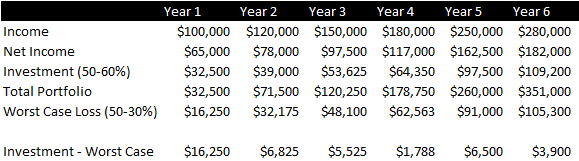
To put this all together, you already know what we’re going to say… Earning more money is significantly better than trying to save more. You will save more naturally since you won’t have time to burn the money and you will be able to *continuously* build your net worth. Now if you get to $20M+ we have no doubt it will be next to impossible to offset a 50% reduction in investments… Unfortunately we are not there yet! For fun, we’d say it is possible to get to ~$700K in annual income for anyone reading this blog (if they are serious). Using a 20% correction as a “worst case scenario reduction” for a diversified group of investments this means you can amass a portfolio of at least $1.5 million or so before you’re even worried about big stock market corrections. If you want to get more conservative you can add to the bond/cash exposure and suddenly you can go up to $2M knowing that you’ll increase exposure across the board! We have no doubt lots of people will hate this post but that’s fine, we’d say it’s better to focus on making more money than poking around doomsday scenarios where everything is down 75%+. And… With that we’ll leave you with a favorite quote of ours “The more money you make, the more risk you can take”. That is why the rich get richer!














How can I find my transaction ID? Checked the email from when you sent out Efficiency and I don’t see an ID there. I could leave my email that I used to purchase it if that works.
It’s in your PayPal account when you sent the payment, thanks!
I am a college sophomore interning at a well-known but not top tier pe firm where I can likely work full-time after graduating if I do a good job. I could probably use this experience to place into an ibanking group for junior internship with exit ops into a better pe firm (e.g. GS TMT, etc). However, lifestyle would be better at medium-prestige pe firm (better hrs and less stress). Would you recommend I continue at the pe firm I’ll be interning at, or try for a better group?
If you can really get into a top tier spot like an EB or GS TMT etc you need to take that and run with it.
If you cannot get in then go with the better life kid market PE firm. Always choose the option that opens the most doors at your age.
As always it depends on the group so we are referring specifically to M&A not the other junk as outlined in efficiency.
You’re 20, you can work 100 hours a week easily. We did that exact model it’s doable.
We deleted your follow up since we allow only one question and covered your “problem” in the past. Long story short it’s BS don’t worry about it. Thousands and thousands of people have gone through the program practically none have any issues.
I have a PhD in math, knowledge and experience in computer programming and am now working for a bioinformatics institute and am learning data science on the side (mid 30s). I don’t know how to turn my knowledge and expertise into a business especially a “location independent” one. Do I have to work for a corporate to gain the know how? I’ve always worked in the academia.
Unfortunately we don’t know the answer as that is not our background.
1) reach out to location independent phds in the same field to see what they do
2) look into corporate as that is more likely location independent long term versus a university (just an opinion though)
So we think your thought process is sound
You have mentioned about buying low cost, boring Vanguard ETFs.
How much of a problem and opportunity is that hundreds of billions $ per year flowing from active into passive index investments/ETFs regarding the (mis)pricing of individual equities and for larger market declines? Would be much appreciated if this could be covered in Triangle Investing.
That will be covered and we touched on it in managing your own book (post)
We would got there for our explanation
If you had to decide on a state to incorporate for affiliate marketing, which would you choose? My primary desire is privacy (from any current employer) / tax benefits. Naturally, I have looked into Delaware / Nevada as potential states for S-Corp, but wanted to ask specifically if there is a single one you would recommend in regards to starting an affiliate marketing company. The goal is to create an S-Corp so I can utilize affiliate marketing offers (i.e. clickbank) separate from my personal taxes.
They have locked hose tricks down pretty hard and it’s difficult.
Your best states are essentially the tax free ones and living in them (Nevada Florida etc) there is a reason why a bunch line in Miami.
Our bigger solution if you can put into someone else’s name and want to be us based is go to the Virgin Islands.
Currently 22, Making 22k USD net this year, likely 100k gross next year working at small PE shop. Low cost of living (Prague), potential for much higher income in future depending on exits.
Don’t have 50k for internet business this year but could easily raise money from contacts.
Is it worth it to raise ~50k and either start from scratch or buy a site on empire flippers? I would take 20% equity to manage the business.
Definitely not, save money for a year and do it yourself with the bootstrap idea in efficiency. We wouldn’t go and buy websites without creating at least a modestly successful one from scratch.
Unless you go down the affiliate angle which was also covered in efficiency.
Long story short, you don’t take leverage on something you don’t understand
Will do.
I appreciate it.
I would like to start a social media and Internet managing agency for nootropics/smart drugs sites and online stores. I live in Norway, and there is a very small or non-existant market for nootropics. Thus, it looks like I’m forced to try and reach clients in other countries. Would you recommend I do this or try another niche with possible clients in Norway?
If you believe you know the market in more lucrative countries you should certainly switch. That is a big “believe” though.
If you know the Norway market better, then you’d get profitable in that country and expand. Nothing prevents you from buying traffic anywhere in the world.
Our guess is you’re better off becoming profitable in the market you know (Norway) then expanding.
Hello WSPs,
I am 19, majoring in MIS at a local state university and will graduate with a ~3.0 GPA a year early (in 1.5 yrs). Since I was a kid, my parents emphasized numeric skills to me, and I spent my whole life up until high school planning to become an engineer and had little social skills. However, in high school I started to fall behind the curve in numerics compared to my peers and decided I needed to change directions (I took advanced math courses, but was definitely not flying through the tests or SAT section as I got closer to graduating).
Since then, my plan has been to enter into tech sales when I graduate college, and I have been improving my sales skills through various customer service jobs since coming to college a year and half ago (I would say I am at the median level now- but started at near ground zero). I recently began interning for a local tech startup in a SDR type role, and it has begun to dawn on me that I may not be able to compete at a top level in this area either as my competition are guys who are naturally social-savvy (unlike me who couldn’t talk to a girl for the first 16 years of his life).
This leaves synthesis as my last option of natural skills that I could leverage to make $$$. Considering my low GPA (I joined a frat and partied too much) and non-target school, I know entering Wall Street would be a long and arduous process that would probably not be worth the effort considering my other options (I could always just keep grinding it out in sales and make 100-200K as a middle-of-the-pack account executive- I don’t think I could ever become a top dog though).
I am considering full-time real estate investing as a viable option to making a ton of cash. I know I have potential in synthesis and finding deals from the past (I used to flip video games on Ebay as a kid- and then later flipped various contraband products as a dumb teenager). There a couple things that are holding me back though which are:
1. It seems like a waste to try to enter REI via the trade school route considering that I am 1.5 years from graduating college with no debt (I have some savings and work part-time)
2. I am thinking about going the agent route to get RE experience with contracts and marketing (I could get my license in college and then later easily get a brokers license in my state if I take a couple RE electives). This would just be a way for me to save up capital for my first property. But, I would definitely be making less $$ and saving up less capital doing this than continuing on the tech sales path.
3. If I continue on the tech sales path, I could begin to invest on the side once I graduate (by using a residential mortgage to buy a small multifamily) but I would have no real estate experience in any form, no trade skills, no experience managing properties, etc. Additionally, it seems dumb to try to go down 2 different paths at the same time.
To sum it up: I can graduate before I turn 21 with a tech sales job, but don’t think I have the natural sales skills to become ultra wealthy that way. I think I can leverage my synthesis skills to make more $$ but don’t know how to do so coming from a non-target school with a 3.0 GPA and a Management Information Systems degree. How would you suggest I try to switch into a more synthesis-oriented position like REI, Wall Street, etc when I graduate?
If you’re going to tech sales there is nothing at all preventing you from building a real estate portfolio as your second leg.
Many tech sales people do this where they start buying rental properties with the money they save, next thing they know they own 10 places and essentially have a second stream of income.
We went the online route but your strategy is perfectly fine (the real estate guys who comment on here would say it works as well!)
Long story short, tech sales overlaps a lot with real estate since the skills overlap a lot.
Wall Street? Seems like you’d be forced to start from square one, we would stick with your path since it will work. If you really want to switch you’d have to fix your GPA to a 3.5+ (assuming its a good school) and then obtain an internship and get into M&A.
Your current plan looks better based on your comment.
What does a typical week of yours look nowadays and how has it changed in the recent years, post financial independence / success /etc ?
Thanks for the great content.
Ha that’s a good question!
There are no real typical weeks anymore, some days feel like “ground hog day” where you have to do the same thing because that’s the task for the day. Other days are spent more outside or traveling.
Would say the common thread amongst us is: 1) working out, 2) reading for part of the day, 3) lots and lots of annoying emails, 4) some traveling and 5) minor meditation.
Hope my question is not related as personal finance question, because I treat it as a business proposal. I come from Slovenia so I am limited with business and career options. But I do have 100k EUR saved and another 50k coming soon. So my question is, what do you think of selling far out of the money iron condors with options on futures (gold, oil, etc). So far I could generate about 2 % a month easily with low risk and this translates to almost 30 % a year compounded. So I can double my money in 3 year, then again and again etc.. Did you dabble with options at any time and what do you think about it instead or pursuing career or business venture, specially for non US and almost 40 years old people 🙂
thanks for reply
That is way beyond the scope of what we’re doing here we don’t know much about iron condors.
If you forced us to we would say no… just buy an internet business and scale from there (ideally start one yesterday) becuase cash flow is more important than writing options on strange products.
Any time someone says 2% daily returns with “minimal risk” it typically doesn’t work out well…
You used to talk about university / career as a hedge. Would you still recommend a high school student consistently profiting $3k monthly online goes to college or focuses on business full-time? (Assumption: Top school to get into IB and minimal $$ cost, but will be 25 by the time I finish university)
That is a personal decision. If you’re certain you can always make more than your cost of living then you are fine. $3,000/month is a lot for someone in highschool but it is not a lot for the real world (after age 25)
So… We’ll leave you to decide on that, the good news is you could probably apply and go to school for free with a killer explanation about being a successful entrepreneur already!
Up to you, if it’s scalable we wouldn’t go and make the money if possible. If it’s not then go to a top school for free and continue working on the business. College is incredibly easy so that may be the right move since it takes only a few ours a day
Would top schools really give you a full ride if you’re decently succesful with a biz at 18? It makes sense since they seek juicy donations long term but didn’t know they’d would do that
I work in a mere $100k job (a comms. agency) but remotely and pay low tax (moved back to a non-Western country, my home). The problem is I’m 31, so don’t have much time…
I’m chosing between:
1) starting my own consultancy (negligible startup costs, avg. 20% margin, semi-recurring income), productizing the services and competing on efficiency. But these shops are are hard to sell and usually have low multiples and earnouts.
2) or keeping the job and starting a side online business. Before reading Efficiency, I’ve already tried a dozen ideas, but got nowhere — wrong niches and no focus.
Which strategy would you recommend?
I’ve got cash to stretch up to 10 months of living expenses. My talent is mainly Intent and a bit of Synthesis.
Thank you!
The clear question is how certain you are that the consulting business will work? if it’s essentially what you are doing now and would work… we would actually choose that one.
Why? well ideally it gives you another $50-100K a year? Then if you’re making $200K at age 31 you can save for 1-2 years and just buy an online business if it didnt work multiple times.
If the consulting business has the same risk as the online one (meaning you don’t know if it will work) you’re better off figuring out the online biz long-term.
Making great progress in my sales career. Thanks for all the guidance you guys have offered to help lead me down a great path.
I seem to be be talented in language learning and have been able to pick up a few in the last year or two. How do I leverage this to make more money?
Unfortunately that’s not the greatest talent since the future will allow for automatic translated words (just think of google translate on steroids). If you’re able ot pick up on syntax faster than most (impressive) it means its good for sales. So you should focus on “what you can sell”, figure out if there is a higher margin higher profitability product you can sell and get on it asap. IF you’re already a natural, the typical trap is getting complacent (don’t)
Long story short, knowing how to speak another language basically opens you up to sell to more people so instead of focusing on learning languages use all your syntax skills for sales!
Trying to build a good understanding of crypto. I got into BTC and ETH in late January 2017 so i’ve done well, but that was just dumb luck. I somewhat understand how bitcoin works, but definitely nowhere near an expert. You said in this post that the books on the subject aren’t very good, so where would you recommend starting?
We’ll cover all of this in the book.
If you want to start now go straight to the source: 1) white papers, 2) youtube explanations only by coders and 3) go and attend the crypto currency summits – they are world wide, and only attend the ones that are specifically for coders
Will your personal finance book include advice for handling student debt? I wasn’t financially literate 10 years ago and didn’t have any of the guidance this blog provides (surrounded by a lot of regular people telling me student debt was worth it).
I’ve leveraged my skills enough to be doing well with the career route for now (data/technology realm). However, I’ve been wondering if your personal finance advice would still hold for someone with large amounts of debt or if you’d be a proponent of aggressively getting out of it before proceeding to make investments in the areas you recommend above.
Unfortunately it will not, it is a purely investing based book.
We don’t know much about work arounds for student debt, we’d suggest researching it and seeing if there are any ways to get it lower
Thanks for the Q&A guys!
Here’s my question:
1) Completely agree with your stance on no goals. Even with no goals, you’d probably like to get past certain “checkpoints” in a relatively quick amount of time. Say for example, you are looking to test demand on a new product and you have the target market + product concept and need to write the sales page. As you know, writing a sales page includes different parts (research, writing, editing), do you set a “time frame” for each part, and then a deadline for the overall sales page? I find that without a deadline, you can end up editing each part the sales page (or tweaking whatever) endlessly in a perfectionist style.
Thanks guys!
Time frames generally don’t work, instead you should plan out each item by day. This isn’t really a goal it is saying “i am going to work on X today” and you’re not allowed to do anything until that part is done. Put the most important item on the list first.
Example: say it takes you 2 days to do the research, then you’re going to dedicate 4 hours each day to the task and you can’t do anything else but eat until it’s done
Then you estimate the number of days for the other two parts (writing and editing)
It’s a lot easier to stay on track by writing down what you will do tomorrow and sticking with that. It prevents you from being distracted and we’ll bet you finish all your important projects faster than anticipated. Just don’t break the rule of getting distracted. Wake up, drink a coffee and eat something and get to work. When you’re done with the task for the day move on to something else.
Thanks! This is helpful and makes sense.
Know this is “nit – picking” but as curiosity to your preference would you still do things break up the focus period with gym or if you’re still employed 2 hours before and after work?
Secondly, if for example you wanted to solve a problem such as “how can I learn to sing” but not until March since you have to launch a business first you’d just set a reminder to start solving that problem then instead of “learn singing in March” as a goal?
Thanks again!
Ha you’re just nitpicking my man. Go to the gym when you want and if you’re gonna learn to sing then just prioritize it. If you’re not financially independent and learning how to sing comes before work we all know what happens next
One of the old posts mentioned dual city living. Could you expand on that a little bit? Sorry for the vague question.
PS – Idea for the book. “How to valuate a paid off residence. Is it like a bond?”
Dual city living is for people who work online. Many find that they enjoy living abroad and in the USA for different parts of the year.
For example if you own an apartment in Moscow and Miami you’d live in Moscow during the better months and retreat back to Miami.
This is just an example but generally living abroad is a lot cheaper with a different set of headaches: 1) not as safe, 2) worse service – good luck getting 24/7 food and 3) lower quality technology. These are just general but the USA is better for convenience/speed.
IF you’re buying places in two cities… you’ve made it so you’ll know when you get there!
Once the privacy measures are in place (Efficiency pg. 112, paragraph that begins “Another example…”), do you obtain a separate: iPhone / WhatsApp / generic sounding Gmail address solely for friends, family, dates and personal banking? (If you even recommend maintaining any bank account attached to your real identity.)
Sure you can do that as well. It really depends on the level of separation you want to put in. You can use things like google voice as well.
The key parts of privacy are there on page 112, and if you want to take it further there is no real downside except a few extra dollars a month in cost.
Long story short, go for it
So we are clear your business bank account should not be at the same bank as your personal one, that’s foolish
Thank you. That was a very fast reply and just what I was looking for.
Am good to go in regards to your last statement. Thanks for warning of the potential pitfall.
Wish you a great weekend and hope the sale reaches 5x…or more! Appreciate everything your team does!
No problem and good luck! Greatest time in history to be alive!
I’ve just started creating websites on the side (check out the website associated with my name and the website above), I’ve haven’t billed people because I don’t think it is of quality/value … yet.
Currently organic traffic is going to the site, averaging 4 a day. I was wondering what steps I could take to increase traffic. I read from efficiency that you guys buy traffic as well as ads.
The question is should I buy ads and on which platform (fb) or traffic? (I have no idea where I should purchase quality traffic).
I am asking you to be radically transparent for any feedback y’all give — so I’m going to embrace any tough love 100%.
Not sure what your question is to be honest. In the book we give you several ways to buy traffic. There is no “good” way to do it. You can make a killing on facebook or you could make a killing on google, it all depends on which one converts better for you.
4 people per day is certainly not going to cut it, you have to get that organic number up a lot by targeting the right key words related to your business. We didn’t go through your website because that would take a long time and is essentially a business review. So ask yourself why it is ranking low on google and find a way to move it up through the stacks
Once you get the products selling then you look to buy traffic. Unless you’re doing affiliate marketing then you go straight into attack mode and can buy traffic from day one.
Good luck, the good news is you got started already so you’re on the right track!
Hey WSP, wonderful time for having a Q&A!
Age: 31 (so short of time..)
Current role: Tier 4 profession in Asset Management (PE secondaries/co-investment)
Potential offer: Have current offer to join MM Leverage Finance role.
Dilemma: Based on the chart drawn on page 116 it seems like a no brainer to go for the MM Leveraged Fiance role. However, the MM Leverage Finance role pays about the same as my current role (both base and bonus) and moving to Lev Finance means giving up carried interest at my fund. So choice seems less obvious to me given my age.
Could I get your thoughts, please.
Thank you.
Hard to tell based on this, if there are promotion opportunities at your current place it is foolish to leave and giving up the carried interest. If you believe you cannot move up, then you should switch roles and ask for slightly more money before leaving.
The same rules apply, choose the one that moves you up the pay-scale the fastest. Everything else is largely irrelevant to be honest.
Both of those positions are great, just need to decide which one = promotion. Thats when the money goes up by 30-50%. Also, you already know what we are going to say, you should have a second source of income by now! So get to work on an internet businesses while you still can
Many thanks for the quick reply. Brilliant that you managed to narrow it down to promotion opportunities. Indeed, they do exist at my current firm so the choice is obvious to me now!
And yes, I am getting started on my internet business already.
Looking forward to your next book! Have a great weekend.
How do you handle a bout of loneliness and emptiness? I’m 23, have no debt, good finance job, I am working long days, going to the gym daily, eating healthy, and consistently working on improving my skills, and working on starting a side business. I should feel happy, but for some reason, I don’t and I’m struggling to determine what I really want to do long-term now.
Most of my friends who also work in finance are miserable, however, they seem to fill the void with alcohol and women, and that gets them through the day. Those endeavors bring me temporary happiness, but its quick fleeting.
I have never felt this way before until recently. I just want to be happy like before.
In recap, did you guys ever go through a phase where you felt lonely and empty? I know that you guys mention that its normal to not feel happy when you’re young, but Its hard for me to move forward (despite all the hard work I put to get to where I am today) when you don’t have as strong motivation and feel lost.
This is probably one of the worst places on earth to look for emotional support/psychology help.
We’ll give it a shot though, if you’re feeling “lonely” you probably haven’t done a good job finding a group of people you like. This isn’t being rude, we’re just cutting to the chase.
Finance people are generally miserable, 1/10 of them or so “get it” and have fun/party here and there and are happy with their lives. Find those guys and find what makes them tick and why they are happy. Hint: they are not the ones with unattractive overbearing wives.
After that, figure out “why you were happy before” our guess is more free time and a different social circle. So you can do two things, realize you need to get financially independent as soon as possible, this will make you want to work on something new (side biz) and do good in your career. The second item is to join groups in your area for your favorite activities before you joined the ranks of Wall Street
Good luck!
Thanks for the QnA WSPs.
As we get more Efficient, how do you start recalibrating from 12-hour workdays to, let’s say, 8?
I am thinking as a first step to add a specific day in the week, in which I will have to dust off my contact “book” and go out with someone.
Looking forward to your upcoming book!
Sure this is just striking a balance between killing off your social life and making money. In general, you can have both a social life and party hard when you’re young (early 20s one of the best and hardest times to be alive)
Then towards around 26-28 you’ll adjust your schedule since the money will start coming in, there is no set schedule when you’re in your late 20s. You’ll typically work in large “waves” where you do a ton of upfront work then do nothing for a while.
Later on in your 30s, you find that having something to do keeps you from going crazy. Many people quit working entirely and just end up with a drug addiction. So in your 30s you’ll actually work hard but it will be in waves again, where you work really long hours for a month. Then do practically nothing for a couple of weeks. At least that’s what seems to happen to the guys who don’t fall off the wagon.
Good luck! It’s not about hours its about how much time you want to spend pursuing other items as the money goes ^^^
Background:
Hispanic male just turned 24. Currently attending LSE for a Masters Degree in Accounting with a Finance focus.
Previously: Attended a Non-target school in the US and graduated with a Econ major and a 3.75 GPA.
Internships : One BO internship during Junior year in a BB.
Questions:
London is not where I want to be by any means(Personal and Health reasons). I want to return back to states, but had no sucess aplying for banking jobs outside the UK(All rejected without interview).
How should I approach recruiters in this situation? (Goal: is IBD regardless of vertical group)
Also, Im high skilled at sales and have considered getting a B2B sales job instead of pursuing Wall Street FO. However, Im deep in the hole with ~50k in loans. Is Wall Street a superior career nowdays than Enterprise Sales for a Target School Graduate?!
It’s essentially a wash choose M&A wall street or Tech sales, you can basically make the same amount.
If you’re a US citizen getting into banking should be easy with your background? There are even special programs for minorities so leverage those. This was also an easy one because you should leverage the minority card to get in. And. If you don’t just go into banking in the UK. It’s a win win
Im a US Citizen. I have been trying to leverage the minority card, but most programs are aimed towards Sophomore/Junior Undergrads. It seems like HR is filtering the resumes by college location therefore not even giving mine a second glance. Any other methods you would recommend besides applying online and sending cold emails?
Also, thoughts on doing FLDP program with Fortune 500 companies ( Think. GE, Coca Cola, Microsoft)??
Thanks for your time again!
Quick note here: Because you’re applying from overseas, be sure to specify “US Citizen” on the resume you submit to US companies.
I’ll be joining a top tier EB (LAZ/EVR/MOE) as an analyst after graduating in June. I am trying to decide whether to pursue private equity or hedge funds after my analyst stint. Which option do you think would provide the better skillset to pursue entrepreneurship, as suggested by this site, if and when I decide to leave my career in finance?
Easiest one of the day! Private equity
Once you learn to fix businesses it’s easier to take that skill set, fund raise and start your own.
Working towards starting a side online biz.
As you’ve stated before, recurring revenue is the name of the game for a e-commerce.
How do you recommend a younger person with limited resources compete with all the existing/big names in spaces that are backed with a lot of VC $ and domain expertise?
Seems like most *good* ideas have been tapped and its too late to play catch-up. Daunting to enter these spaces when they’re all saturated with $$$ and established names. Affiliate marketing is an option, but hoping to go the “real” route.
Thanks for doing the QA.
Well we gave a very basic example in the book. You can tie emotion to quite literally any audience in the world for any product.
You could even make a cool pen that is emotionally charge, the options are that vast.
We can’t give you an idea out the gate, if you really can’t figure one out start with 1) affiliate marketing or 2) buy a niche website and scale that one.
Competition isn’t really an issue because the entire sales process is emotion. Differentiated products rarely exist and the ones that do are essentially monopolies so worry less about having some killer edge and worry more about the emotional appeal.
Worst case, as always, go into affiliate marketing so you learn the business side immediately
Hi WSP – am 24, work in a rating agency (dead end) earning $80K per year. Have lots of spare time and am focusing on creating two online businesses (one consulting and one product). My main strength is in sales – would you suggest I start my career/job from scratch and move into enterprise sales? Or structured product (thats what I focus on now) sales in an IB? Thanks
With your background and age it likely makes the most sense to go into enterprise sales!
Luckily we have a post on just that using the search bar
Background:
21-year-old white male; senior at top 20 university in The States; accepted post-grad offer with a large investment vehicle that makes direct investments in private equity, venture capital, and real estate. PE job is in a non NY/SF city but is in a state with very low taxes (Florida/Texas). Comp is competitive, in line with 1st year pay on the Street, adjusted for non NY standard of living.
“Goals” of being location agnostic w/ a biz, and numerous income streams; learning AM right now (despite not having excess capital at the moment to test offers and buy additional technologies/platforms like justcloakit, adplexity, etc.).
Question:
It is without doubt that some of your readers will “make it” at some given point in time. Whether that is defined as a quantifiable monetary sum, being location independent, or being emotionally satisfied remains to be seen. However, like dogs chasing again and again after fleeting squirrels, many of us climb quickly up the ladder of life but ultimately remain unsatisfied.
From what I understand, it is these kinds of people that move a nation forward (Rockefeller, Caesar, Trump). However, to what extent is legitimate class mobility possible for these kinds of individuals. i.e. they acquire wealth, political influence, and widespread admiration, but often end up with a sub-par private life or marrying a spouse that was born into the same class as they were?
In The States, for instance, is it realistic for a minority individual born to a low-income/class family to dream of one day joining the ranks of the aristocracy/politically influential? While the individual may become a billionaire, they still might not belong to the same social circles (class) as they had hoped they would.
Personally, I believe this kind of mobility is attainable (although costly both mentally and psychologically), but I’d like to hear your personal thoughts on this topic and how it has changed since you were our age (21-30ish).
Lastly, many thanks for the great content over the years. It has changed my life and the lives of other ambitious young men for the better!
Regards,
$Train
Ha that is more of a philosophical question than anything. The typical BS response is you can get into “any” group you like.
The reality is that we’d say 99.9% of groups are achievable. If you get into billionaire status there are practically no groups that won’t allow you in. However… There are always exceptions. Some billionaires hate other billionaires which then make that group impossible for you to break into (or near impossible)
Social class is extremely easy to move up in the United States today (that is if you care to do so), but you’re talking about the top 0.01%. At that level there are always strange groups, think of Trump trying to join the democratic party or something like that. It just wouldn’t work.
Overall, most people should focus first on taking care of themselves and their families, becoming a millionaire (or more!). Then taking a step back and asking exactly what they want.
There are MANY millionaires who hate their lives and live in quiet desperation. We are sure you know this based on your old posts but they are more common than uncommon.
Appreciate the quick and insightful response – millionaire first then we’ll cross more bridges as they come.
Cheers to being alive when it is best to be so!
What is your review of this? any advice?
Not sure how to help on advice for the idea you wanted us to delete. It sounds like it can work… so why not try first and come back when there is an actual issue to address. No one gets paid with “ideas” or new projects
Long story short sounds like it could work (a good thing) but we have zero experience in doing a business like that
What’s the oldest book (ie classic) you guys have read and has been influenced a lot? For instance The Prince is 485 years old.
Not that close to classics, perhaps atlas shrugged but probably not old enough.
Currently a junior at a target studying electrical engineering. Managed to pull out a 3.5 GPA and had a good amount of interviews for IB recruitment (~9) but unfortunately struggled to pull away with an offer. SA recruitment pretty much done at this point.
After evaluating my options, I think my next best step is to get the best possible internship I can find and hopefully I can get a FT offer from it. I am considering o&g engineering, commodity trading, other finance roles (don’t think I am smart enough for quant finance). I’ll try to recruit for FT again in the Fall, by keeping in touch with all the places I have interviewed. Worst case scenario, I will have a job lined up by graduation with the option of reneging if neccesary.
Despite going through engineering, I realized I haven’t learned anything tangible. Wished I studied CS because the options are limitless. Between now and September, I will try my best to self-learn cs/programming and might swing for software engineering roles as well (maybe even a minor?). Regardless, I think having the extra skillset is an edge that could transpire to any field, whether it is working in finance or in your business. Plus, being able to understand blockchain at a technical level would only help. Overall, I think SE has more upside than going into IB but I have a lot of catching up to do.
On the side, I have an online business plan that I feel is promising. High margins, low startup cost. Will try to execute as soon as possible by testing demands using paid traffic first and if picks up, I might not even need to go into a career. (with the extra cash flow, I will flow some into cryptocurrencies)
My question is: am I thinking logically? In the heat of going through waves of rejection, I might not be thinking straight. Are there any issues or recommendations you could share based on what is presented?
Yes you should continue ramping your online business. In the meantime look for any other internships while you can (doesn’t have to be investment banking) stay the course and go into one of the legitimate careers.
All free time is for business and that’s essentially it. You’re doing everything right so far so it looks good, just bad news on the internship. Find something new ASAP and continue to focus on your idea in the extra down time.
“The crypto currency exposure is not the same because it does *not* print money for you.”
I understand where y’all are coming from, but that’s not quite true.
Each crypto asset uses some type of consensus algorithm to secure the network and establish a valid history of transactions. These algorithms (for the most part) work by financially rewarding honest nodes that correctly run the software and “play by the rules” while punishing malicious nodes that attempt to subvert or attack the network with loss of collateral.
Bitcoin, for example, employs a proof-of-work algorithm where “miners” use specialized hardware (and lots of electricity) to secure the underlying cryptographic ledger. They compete for the privilege of adding a new batch of transactions (a block) to the existing chain of blocks (hence “blockchain”), and every ten minutes the winning miner is rewarded with new bitcoin (plus transaction fees from that block).
Other assets use a proof-of-stake protocol instead, whereby existing value (in the form of the network’s native token) serves as your ticket to a pseudo-random lottery. Winning nodes are allowed to process transactions/add new blocks and earn additional tokens for doing so – but the preexisting tokens stored in the node’s wallet are frozen while that happens. If users try to steal from or attack the network, their collateral (the value at stake, hence “proof-of-stake) is lost. You’re only allowed to play if you have financial skin in the game.
This process establishes the same game theoretical incentive structure as proof-of-work, but uses MUCH less electricity and doesn’t require expensive hardware; often a tiny computer like a raspberry pi is all that’s needed to run the software.
Even better are proof-of-stake utility tokens, which play an integral role in the functioning of the network and earn the value that would otherwise go to a centralized third party (like transaction, escrow, or listing fees). The Ethereum network, for example, charges a small fee in order to execute a smart contract. As demand for contract execution increases due to decentralized applications (dApps) deploying on the network, demand for ETH will increase and its value will rise.
When Ethereum switches from PoW to PoS (currently planned for late 2018/early 2019), ETH holders will be able to earn interest simply by leaving their tokens in a node on their computer (assuming it’s turned on and connected to the internet). Same goes for networks aiming to disintermediate Amazon, eBay, Uber, PredictIt, YouTube, and more.
These benefits form positive feedback loops, by which token holders are incentivized against selling, which drives up the price, which improves the cash flow, which further incentives holding, locking up additional supply, pushing the price up further, and so on (DASH and its masternode structure is a great example of this). How’s that for a high-interest savings account?
To your initial point, the volatility/price uncertainty of crypto doesn’t make for as predictable of an income stream as RE. But to say that crypto can’t “print money” or generate passive income is to miss a very big mark. It’s simply that most of these projects don’t release their platforms/MVPs/betas until next year, and with Bitcoin stealing the spotlight it takes diligent research to discover these additional opportunities. But I fully expect that to change with all the developments slated for release in the next 6-18 months.
Hahaha yeah we left it simple we are well aware of the crypto dividend aspect it was a short summary. You can always mine and print them as well!
As you know proof of stake got pushed many times as well for eth so who knows exact flip date
Great insights Jon.
It might be hard most people to stake for ETH because it requires 1000 ETH to be a node which might be close a 1M when they finally switch over.
There are quite a few other projects which uses PoS like PART which doesn’t even require min tokens. I view them almost like real estate as there is passive income coming in as well as the equity of the token will rise over time.
PoW does require you to keep up with hardware updates as they get outdated pretty fast. 1 month in crypto is like 1 year in the real world.
There are also some tokens that burn from the total supply (ICN, REQ) to bypass the SEC regulation of what constitutes as a security.
Great blog BTW. Always enjoy every post you guys post.
Unbelievable comment.
Thanks.
Question for you, Jon:
As a simpleton putting money into ETH as a simple store of value on Coinbase, does current ATH seem very very low to you?
For example, in late 2018/early 19 like you mentioned, do you anticipate the price skyrocketing?
Is this really where the knowledge base is? If so people have a lot of learning to do.
Ethereum should be valued more than bitcoin in the future if the applications work.
Thanks Michael. Good question. The long answer is too long for a comment here, but the short answer is yes, I think ETH has plenty of room to grow.
While it’s difficult to value many of these assets, sentiment and hype alone should drive the ETH price up throughout 2018 (although don’t get me wrong, I think Ethereum’s fundamentals surpass just about any other project out there, including Bitcoin).
Most people have yet to fully comprehend its various use cases, and I think once we get closer to PoS and the market realizes ETH’s potential as a passive income-producing investment, we’ll see a rally that could rival this year’s performance.
I’m about to be turning 22 and will be finishing up college next semester. I already have an enterprise sales job and that is my going to be my career path. I have a high GPA and school next semester will be a very low priority. I was wondering if you have any advice for what a second semester senior should do? I’m in a fraternity and could party the whole semester if I wanted to (very unhealthy). I’ve been developing my intent intelligence, but I spend a lot of time reading and literally feel paralyzed from too much information. I don’t have the money to start a business, but I do enjoy researching companies, websites, and reading copywriting (good copywriting pumps me up). Any advice for this next semester would be amazing.
Thank you so much for providing all of us with this great information. It’s a great time to be alive!
Not sure what you mean your question is directly answered in the book. Start an online business asap get a head start. Once it’s profitable feel free to relax
Great stuff gents,
You guys read. So I am interested in what you are reading and what books you have recently finished that left a mark on you.
Also do you have any recommendations for any further reading e.g. other blogs that you follow, etc.
I have a few weeks of downtime coming up and want to spend some time reading!
Nothing new really just a lot of white papers for crypto related items it was time consuming the last two years or so.
Beyond that you can check out the Sovereign Individual or Snow Crash
Currently in SaaS sales as an SDR but I don’t think I have the ability to be a top performer.
Always been more of a numerics guy (Top 20 school STEM major), but I thought I’d be able to learn sales skills enough to do well.
Question is, if I’m looking to move into technology, what positions are best to go after? For example, is my best bet to network my way into a software engineering position or try to spin my sales experience as relevant to something like product management?
We never worked in enterprise sales, so we can’t really help just spin your experience into something that fits your skillset.
Going into enterprise sales with numerics skillset doesn’t make much sense perhaps try to go and become a quant or one of the items listed in the numerics seciton
That or improve sales skills and stay put!
I was actually numerics but couldn’t find my way into an HF and my main industry was decimated.
Sales engineer sounds perfect for you. Top ones pull 200k+ with a fairly easy job (no quota).
Do you consider online businesses that connect potential customers of a service with small businesses in a certain niche, or managing online ad $, etc. to be viable alternatives to product based businesses?
Confusing question, connecting people is essentially social medial like linked in so it works
If you manage someone’s ad dollars that is definitely a business because you’re the pot of money
So in short both work
I’m guessing that’s the transactional number
Some of the investment product you recommend such as Realtyshare seems to be only available to people residing in the US. is there any possible options you have for your readers in the UK?
P.S. your blog has helped me a lot.
We are not located in the UK and only know US based products
You should search for similar opportunities in your area, we don’t know anything about the UK so we would be of zero use!
This is going to sound like a silly question and I’ll briefly outline the scenario:
Age: 29
Current job: Working with family to develop/sell homes.
Current Income from last project sale: ~$650,000
Problem: Feel like I’m semi dead inside and just bumming/getting through by my family’s money and I feel like I didn’t really do much to earn that money. Sustainability of business (need to constantly find property to develop/flip) is also another problem – but we’ve been doing this for years and always make around $500K-900K depending on the market. Argue with family alot over petty issues when it’s just me taking my anger out on them.
Question: Do you feel that having a high income is more important than having more of a passion in what you do? I do enjoy this work, but I feel like unfulfilled and bored to an extent.
Possible Solutions — Should I:
1. Stay the course and keep doing this for a while ( by then I’ll be in my mid-late 30’s and won’t be hireable anywhere, won’t really have a ‘white collar professional network ‘ since I won’t be around people who are working finance jobs etc) and hope it works out financially? (I am 90% sure that it’ll be fine money wise)
I can also try to start an online business on the side and hope to grow it from there.
2. Apply to other industries / get an MBA etc ? I feel like there is NO job that I can get that will pay the same amount of money to me with the same flexibility/autonomy as I have now unless I climb the ladder for 7-10 years or get lucky at a start up (lol). I used to work in PWM and the top people there were making 7 figures a year. Long shot to get there, but you never know. Goldman won’t hire you unless you’re ivy league.
Please save my life. This constant debate is depressing the hell out of me.
Love you guys.
Thx
Lol we hope this is a joke stay where you are and keep making money. Your average MBA guy barely makes $200K why would you want to network down? Not worth your time.
IF you really cared about getting out you would learn online businesses and buy them/start one while doing your normal work.
Easy answer don’t quit keep stacking money and either quit and retire when you’re done or build something different. MBA/Professional experience is a colossal waste of time if you’re making $650K.
This was the funniest post of the day we laughed out loud because it’s so ridiculous! keep the $$$
Haha, yeah it is pretty ridiculous when all things considered. I guess I just feel a lack of passion / and intellectual stimulation.
But money is nice and can’t complain if I can stack it up at a young age over 5-10 years.
Loved your ‘why would you want to net work down?’ – totally 100% true. I guess I just feel like people who work in tech/high finance later in their careers when they hit their peak can also make 500k-1mm+ and get rich with stock options etc. But everyone’s situation is different and I’m blessed with what I have already.
“MBA/Professional exp is a colossal waste of time if you’re making $650K” – also lol’d at this. Totally true, but just felt like there’s more options if I were to pursue that. I know a guy who makes about ~10 million a year and his son pursued an MBA but ended up joining his father (because lol, why the hell would you walk away from an 8 figure/year business.
Thanks again for the advice.
Oh and also – it seems to me that your advice is also to pick a sure thing/money over passion for now right? I know that I can stack up the cash doing what I do now, but I just feel bored lol
Yes
Passion is for losers. Find passion when you don’t need the $
When should you *pivot* in your career? Following earlier advice to find a scalable career managed to get a buy-side role in a big pension fund (non-US) in 2015 (I know in Efficiency you don’t recommend the markets side of finance).
Played the “office politics” of the role as you recommended (saving best work for CIO, Head of Research & Head of Equities) so had firm handshake deals to move onto a real compensation package, but the whole team got replaced (gotta love Inv’t Board politics) Q4 2016 and has since moved into many different companies, but no-one seems to be able to provide me with a solid offer.
Avoided unemployment by shifting to helping manage the $3-5bn private portfolios biz/dealer group research side, but that team just got decimated and have gotten my severance.
Given the future direction of the market and current tough layout for employment in buy & sell-side, should I continue along this path for the *event* income (good year profit share, starting my own shop) given that all my co-workers say that I’m a bright young (26-28) analyst and feel I have a good skill-set for work, or instead shift into Sales, esp. Tech sales given prior post(s) about it.
Thanks in advance WSP!
You pivot when you hit the ceiling. Meaning you’re sure or next to sure you won’t get promoted. This is the main reason to get a second source of income up and running immediately so…If you have to pivot (hit the peak) you can afford to take a risk such as switching entirely.
Your position is actually great if you can get a second source of income, those careers are not nearly as stressful so you should have the time!
Appreciate the quick response!
In this case currently have no role at the moment, having just been made redundant (awaiting 2nd round interviews with a few big shops).
So will focus on building a source of income (which I should’ve already done), and attempting to get a role in my area, failing that in 2-3 months will be cold-calling people offering them the opportunity for me to make them money with sales!
Background:
Canadian. Graduating next year, starting 180k with TN and then H1B visas (which won’t allow me to have a side-venture…for the next couple of years). Currently have a side-project that makes ~250/month with <1h of work per month, but I can see it scaling to cover my salary (with a lot of effort). And I have low risk tolerance.
Do you think it's useful to build into a managerial role as preparation for creating my own venture? Or is it kind of pointless because the starting skills you'll need come from being an individual contributor (IC)
I'm pretty strong as an IC (have been told by multiple senior developers) and prefer that, but it doesn't seem like being an IC scales.
Thanks,
college_swe
Managerial role? We hope you are joking. You’re not going to learn much, if you really think you can scale the business you should do exactly as outlined in efficiency. If you’re already well liked… just make sure you’re always in-line for promotion. After that 1,000% of your time is spent on your side project. If it’s already profitable and can scale to cover your current income you’re crazy to take the eyes off the ball.
Make sure you’re still liked at work, then get to focusing on on what matters, your current idea. You’re young so you can do both easily.
Thanks for the response. Think that was a bad question because it’s a future scenario. But got the manager notion out. And will be spending time starting in school then on my project
I graduated in 2015 degree in ecomomics and sold my first company for $400,000 i built in college. I invested in a couple Airbnb properties that doing great; paying the mortgage and making pretty substantial profits. Problem is i’ve been living off this rental money enjoying life.
Obviously I can’t keep living this way…. I’m in the process of starting up 2 more online ventures. As you know there’s a lot of down time waiting for samples, waiting for sea freight, things to get indexed ect.
During the downtime i tend to fall off and start focusing more on mma and shit instead of business. I’m thinking of opening a media agency and selling these old money companies new websites, ppc, fb ads, social media content, ect. basically just hustling the rich fucks that don’t know shit about modern marketing. I plan on only dealing with B2B companies that are willing to drop $30k-$50k initially with $4k-$10k monthly retainer/service fee. There’s no real business start up fee and it’s just straight hustler farming leads, closing and collecting checks. For most companies this is a rounding error and a great tax write off. Whats your thots?
Yeah this looks solid! Sounds like you just got lazy after your first hit, go ahead and get started and come back once it’s in motion
Thanks for all the great stuff as usual!
my background:
1) graduated from college this year and currently working in the engineering industry with lots of exposures to higher-up within company and industry as well.
2) living in one of the most expensive cities in Asia where one couldn’t find much options renting in the central location less than $2000/month.
3) average wage for part-time job in the area is quite low (~$6/hour *without* tips)
4) my routine is quite similar to what you have outlined in Efficiency but haven’t started any meaningful online business yet.
How do I better leverage my time/situation to increase my income over time?
Sounds like you answered your own question? Two ways to increase income get into a better career or start an online biz. Easy answer!
First of all thank you for the top notch advice you guys are giving.
The question:
I work as an engineer on a ship. My work schedule is 2 months onboard (working) and 2 months at home (free time).
After buying your book I now just started spending all my free time building an online business.
The problem is 6 months out of the year I am on a boat with limited internet access. (In worst case scenarios I will be w/o internet access for 2-3 weeks at the time).
In your experience does it make it harder/impossible to run a business when you are not always available?
I would definitely think it is possible to automate the business or have a friend take care of it in case of a crisis. Yet I have a free question so I would like your take on it.
I am 29 (Starting a career it not feasible at this age, with my current education) and I make more money at sea than I would be able to ashore + I like the work. And the amount of focused work I am able to put into a business in my months at home is also a big plus, compared to working a 9to5.
So my plan is to hustle hard at that second income stream until I make it. Unless you think it is absolutely impossible to do it that way.
In your case you will need a product based website. Naturally consulting or something like that will be difficult.
It won’t be easy but you’ll need to hire a few contractors and perhaps an admin once you get profitable. This is to act as a customer service rep.
The second option is to buy a high page view website generating money from ads/news type site. Then you create a ton of content and have someone else click publish when you’re gone.
Long story short can be done just choose something where you can hire someone later. Or find a group of people you really trust (family) to work with you
Also you could always go the real estate route and get property managers
Starting online biz on the side, could you let me know if these are the steps you recommend?
1) build seo organic affiliate site for niche selling physical products
2) once gain traction and conversions occurring proving I know how to sell to audience, start experimenting with paid traffic to same type audience
3) once I understand how to sell to the audience via paid traffic create slightly differentiated product sell to same or similar audience
Biggest concern is that selling physical products as an affiliate via paid traffic may be hard to get profitable as the payouts tend to be for seo.
Thanks for the years of help!
Yes this is a perfectly sound outline. Get started everything is in the book to get profitable within the first year
You make starting an internet company seem like a walk in the park but so far I’ve been struggling with selling products online. It seems like the market for re-selling is SATURATED and major companies have dedicated seo experts to keep their product ranking high.
What do you recommend for 2018? I know ecommerce is only getting bigger but dropshipping, amazon fba is starting to look dead end.
If you trying to sell an emotional product, say, anti aging cream, how do you recommend getting customers? There are 1000s of comparable products with slick copy and an established fanbase. Buying traffic nowadays has a much lower ROI (in my experience, unprofitable…) than a few years ago. Also where can you find existing products to sell that aren’t sourced from alibaba?
Thanks guys!
We gave a lot of ideas in the book the exact same markets are always going to be hot becuase people don’t change. Selling to women is more profitable 99% of the time and there is no way that average consumers are going to stop spending on insecurity products (unless hell freezes over)
Beyond the main markets we recommended in he book we also stated that brain pills will likely be big. We didn’t go into it becuase it wasn’t close enough (adjacent) to what we do now.
If you’re really struggling you can always buy a poorly run website that can be improved quickly. The problem as you can see is you need to succeed first. Which I what we recommend (succeeding with a small business so you understand if someone is doing something wrong).
There is no change to any of our recommendations quite literally nothing has changed at all!
By the way it is never a walk in the park but it’s the easiest business to start by far since you can do it while at your starting corporate gig. That’s why it’s the best option to us.
Efficiency mentions to find keywords with “a decent number of searches ~100-1,000+ a month for example”
For “A Landing Page with No Updates” — I’m confused about how to get enough traffic with only one / few pages.
Does the LP target multiple keywords on a single page (from what I understand it’s harder to rank for KWs this way) OR is it something like 10 pages/KWs with 500 AMS on average w/ 10% conversion rate and $4 per sale = $2000?
Thanks in advance.
Not sure what you mean key words are for search a landing page is a sales page.
I’m referring to the “A Landing Page with No Updates” (pg 144) where it says “Roughly speaking say it takes about a year to get enough traffic to earn $2,000 a month.”
Given the year’s worth of time, I assumed the traffic source would solely be via search. Is this right?
No, you should be using some basic paid traffic to get to a few thousand that quickly. Generally pure organic takes 2 years to get to $3-4K a month.
We used 1 year because it’s standard for paid and is possible (stretch case) organic
As always you could make $0 or $10K a month your first year we jut used general rules of thumb
What characteristic(s) make a partnership worth forming. It has been said that you should go at it alone with an online business most of the time. What makes this blog (“not a business”) and your online sales business different from a partnership perspective? Thanks.
Hahaha never do partnerships if possible. Only case is when both parties are of equal wealth and similar skills (practically never)
This isn’t a business becuase the money is a joke, it is irrelevant and blogging for money is peanuts compared to real product businesses. Unless people think a few bucks a month is “a business”
I was recently introduced to a new product which you drink and it puts your body into a state of ketosis in 60 minutes (benefits are uncapped)
https://healthycanada.pruvitnow.com
(Don’t give any feedback on the site, I don’t care about that)
My question is that rather than promote the product, I could use the entire business model to introduce people to starting their own online businesses. BUT, this would be network marketing.
Do you think there is a profitable market for a network marketer in 2018, provided I do it the correct way? To clarify, I would encourage people to start their own online businesses rather than focus solely on pushing products only.
Tons of opportunity for network marketing so yes. The question is if you’ll be able to excecute. We didn’t look at the site and never went into that space so we’re not the right people to ask.
As always if we don’t know we say so, we’ve never done that business.
Hello WSPs,
I am 23 with a strong talent in numerics. Did undergrad at non target. Currently doing a Math Masters at a top university.
Question:
If I go for a Quant position what kind of position (ie Quant Analyst, Quant Researcher etc) and what kind of firm do you think I would be better off aiming for (ie bank, hedge fund etc)? More specifically what does career progression look for each of these?
Admittedly job satisfaction is very important for me, so Quant Research would be more fulfiling. I just dont have much data on what’s on with career progression in such positions.
You’d have to look at all the major quant based hedge funds.
We have never gone down that path but all the major banks and major hedge funds will hire quants. Whatever you do, don’t go into academia.
There isn’t much we can say beyond that we have a book recommendation you should read in the approved section (how quants took over Wall Street). Then reach out aggresssivley to quants using the same exact model we have out in he comments section and the blog
Quant at a bank is absolutely nothing like quant at DE Shaw. Bank quants build pricing models. MFE needed as this requires stochastic calc, differential equations (tho not _that_ much for either) plus basic options pricing and econ knowledge. Comp is not great and plateaus very quickly. Work is also quite boring with little exit ops (no one needs a desk quant but banks).
Quant at Shaw and the top HFs is pure research and where the money, interesting work lies, with the caveat that it’s infinitely riskier. Even here the work is *not* ‘pure research’ as no one has time for that. Actual models used tend to be very simple, making the data usable for analysis is the real challenge. PhD is likely necessary to get in, though exceptional MS and BSs get in more often than people think.
Thank you for the help!
Looking to start generating income online, most likely through affiliate marketing.
Resources you’d recommend to learn about the topic?
Is there a book or blog that’s the equivalent of ‘Affiliate Marketing 101’ ?
Everything you need to start is in the book? Everything else sold in that space is trash scam products. They just trick you into saying something was learned. No one will give it away, most you get is the tools and after that it’s up to you
I am currently a first semester freshman at a non target (transferring to a target next year). I am on my way to finish this semester with a 4.0 Though, I do realize that a great GPA is not enough to make it into IB. Networking will be key. How should I go about getting my first finance/IB related internship as a freshman and how do I ask people who have connections, like club members & professors, to hook me up with an internship?
Thanks
Answered this in the book and it’s on the blog.